


July 27th, 2026
Nature Communications Publishes Breakthrough Study Showing How COVID-Era Immune Memory Can Be Redirected to Fight Cancer
Celloram, Inc., University Hospitals, and Case Western Reserve University unveil PROTEXI, a novel cancer vaccine platform advancing toward first-in-human clinical trials in sarcoma patients.
CLEVELAND, OH — July 27, 2026 — In a discovery that could redefine the future of cancer immunotherapy, scientists from Celloram Inc., University Hospitals, and Case Western Reserve University have developed a novel cancer vaccine platform that transforms the impact of the largest immunological event in modern history – a synchronized mass immune memory generated through SARS-CoV-2 infection and vaccination – into a powerful ally against cancer.
Published this week in Nature Communications, the study introduces PROTEXI, an innovative dendritic cell vaccine platform designed to harness pre-existing antiviral immune memory to amplify the body’s natural ability to recognize and destroy tumors.
The findings suggest a fundamentally new approach to cancer vaccine design: rather than building entirely new immune responses from scratch, clinicians may be able to redirect immune memories already present in billions of people toward fighting cancer.
Cancer vaccines have long held tremendous promise, yet many have struggled to generate sufficiently robust and durable immune responses, particularly in so-called “immune-cold” tumors that evade immune recognition and remain resistant to existing therapies.
PROTEXI was specifically designed to overcome this challenge.
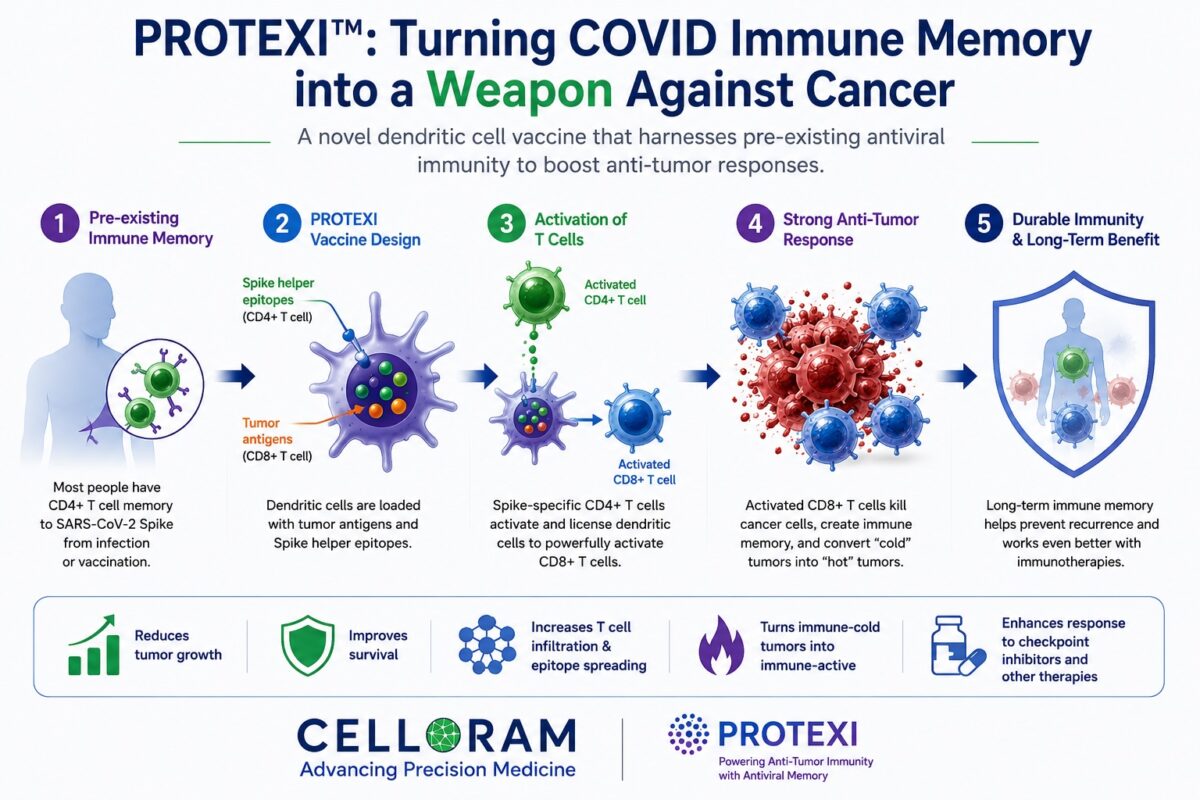
By pairing tumor-specific antigens with helper signals derived from SARS-CoV-2 Spike protein epitopes (small Spike protein fragments recognized by immune systems primed through prior infection or vaccination), PROTEXI converts dormant antiviral memory into a catalyst for antitumor immunity.
In multiple preclinical models of melanoma and breast cancer, PROTEXI slowed tumor growth, improved survival, and transformed tumors that typically evade the immune system into ones that could be more effectively recognized and attacked. The vaccine strengthened the body’s natural cancer-fighting defenses, generated long-lasting immune memory that may help prevent recurrence, and worked even better when combined with other immunotherapies. Importantly, its effectiveness was also demonstrated in humanized mouse models using immune cells from COVID-19-vaccinated donors.
The study showed that PROTEXI leverages pre-existing antiviral CD4⁺ helper T-cell immunity to strengthen tumor-specific CD8⁺ cytotoxic T-cell responses and generate durable antitumor memory, representing a significant advance over conventional dendritic cell vaccines. The platform significantly reduced tumor burden and improved survival in multiple preclinical models.
A New Paradigm in Cancer Vaccines
“Rather than inventing a completely new immune response, we are enhancing the ability of the immune system to recognize cancer by leveraging anti-viral memories it already has,” said Dr. Tej Pareek, Chief Executive Officer of Celloram Inc.
“At Celloram, we believe that breakthrough innovation often comes from looking at familiar challenges through an entirely new lens. Instead of asking how to build increasingly complex cancer vaccines from scratch, we asked a different question: Can we harness the immune memories that billions of people already possess and redirect them against cancer?
PROTEXI represents that ingenuity. By transforming pre-existing antiviral immunity into a therapeutic advantage, we believe this platform has the potential to overcome some of the most fundamental limitations that have hindered cancer vaccines for decades.
Equally important, this work demonstrates the power of collaborative innovation between academia, clinicians, and biotechnology entrepreneurs. We are tremendously grateful to our partners at University Hospitals, Case Western Reserve University, and MedPacto, whose shared vision made this possible.
Building upon these exciting findings, we are actively advancing PROTEXI toward first-in-human clinical evaluation in patients with sarcoma in partnership with University Hospitals. Our ultimate goal is simple yet profound: to translate scientific discoveries into meaningful therapies that extend and improve the lives of patients who currently have limited treatment options.
Scientific Discovery Meets Clinical Translation
“We sought to answer a fundamental question: could the immune system’s memory of a viral threat be repurposed to recognize and eliminate cancer more effectively?” said Dr. Seunghwan Lim, corresponding author and Vice President of Research and Operations at Celloram Inc.
“The preclinical data exceeded our expectations. PROTEXI not only enhanced tumor-specific immune responses but also reshaped the tumor microenvironment, expanded immune memory, and improved responses in models resistant to current therapies. We believe this strategy has the potential to redefine how future cancer vaccines are designed.”
From Discovery to Patients
“For decades, researchers have recognized the importance of helper T cells in generating durable antitumor immunity, yet identifying clinically useful helper signals has remained a major challenge,” said Dr. John Letterio, senior corresponding author, Director of the Angie Fowler Adolescent and Young Adult Cancer Institute at University Hospitals Rainbow Babies & Children’s Hospital, and co-Leader of the Developmental Therapeutics Program of the Case Comprehensive Cancer Center.
“PROTEXI offers a compelling solution by redirecting robust antiviral immune memory toward tumor eradication.”
What excites us most is the translational promise of this approach. These findings have provided the scientific rationale to advance this platform into first-in-human studies for patients with sarcoma, a disease where innovative immunotherapeutic approaches are urgently needed.”
This publication in Nature Communications marks an important milestone for Celloram, but for us, it is only the beginning of what we hope will become a new chapter in precision cancer immunotherapy.”
Leveraging One of Humanity’s Largest Immune Experiments
“For many years, cancer immunotherapy has focused on identifying increasingly sophisticated ways to stimulate antitumor immunity,” said Dr. Seong-Jin Kim, Co-Founder of Celloram and Chairman of MedPacto Inc.
“What is particularly elegant about PROTEXI is that it leverages one of the most powerful biological resources already present within the human population: pre-existing antiviral immune memory.
The concept is both innovative and practical. Instead of relying solely on the difficult task of identifying effective tumor-specific helper antigens for every patient, this strategy harnesses highly immunogenic viral responses that already exist in most individuals. The result is a potentially more robust, coordinated, and durable antitumor immune response.
The translational potential of this platform is especially exciting because it opens opportunities for broad applicability across multiple cancer types and combination strategies with existing immunotherapies.”
Advancing Toward First-in-Human Clinical Trials
Building on these findings, Celloram and University Hospitals Cleveland Medical Center are advancing the PROTEXI platform toward a first-in-human clinical trial in patients with sarcoma. The planned study will evaluate the safety, feasibility, and immunologic activity of this personalized dendritic cell vaccine approach and represents an important step toward translating this discovery from the laboratory into a potential treatment for patients facing cancers with limited therapeutic options.
While additional clinical studies are necessary, the investigators believe these results establish a compelling scientific foundation for a new generation of cancer vaccines capable of transforming the immune system’s existing memories into precision therapies.
If successful, PROTEXI may offer hope not only for patients with sarcoma, but also for a broad range of immune-cold and therapy-resistant cancers that continue to evade today’s treatments.
About PROTEXI
PROTEXI™ is a proprietary cancer vaccine platform developed by Celloram and is protected by a growing international patent portfolio covering its novel approach of harnessing pre-existing antiviral immunity to enhance anti-tumor immune responses. The technology is designed to amplify cytotoxic T-cell responses, broaden immune recognition through epitope spreading, and establish durable antitumor immune memory.
About Celloram Inc.
Celloram Inc. is a Cleveland-based biotechnology company focused on developing transformative immunotherapies and precision medicines for patients with serious diseases and unmet medical needs. Through scientific innovation and strategic collaborations, Celloram is committed to translating breakthrough discoveries into therapies that improve and extend patients’ lives. For more information visit https://www.celloram.com
About University Hospitals / Cleveland, Ohio
Founded in 1866, University Hospitals serves the needs of patients through an integrated network of more than 200 locations, including hospitals, outpatient facilities and physician offices in 16 counties throughout northern Ohio. The system’s flagship quaternary care, academic medical center, University Hospitals Cleveland Medical Center, is affiliated with Case Western Reserve University School of Medicine, NEOMED, Oxford University, Technion Israel Institute of Technology, and National Taiwan University College of Medicine. The main campus also includes UH Rainbow Babies & Children’s Hospital, ranked among the top children’s hospitals in the nation; UH MacDonald Women’s Hospital, Ohio’s only hospital for women; and UH Seidman Cancer Center, part of the NCI-designated Case Comprehensive Cancer Center. UH is home to some of the nation’s most distinguished clinical and translational research programs, with more than 3,500 active clinical research studies underway — the most of any health system in Ohio. Research funding has grown from $160 million in 2020 to $237 million in 2025, supporting discoveries that improve patient care and population health. UH’s academic, research, educational and clinical excellence has earned recognition among the world’s leading academic medical centers, ranking #15 globally and #7 in the United States by UK Brand Finance. UH is also home to 19 Clinical Care Delivery and Research Institutes. UH is one of the largest employers in Northeast Ohio with more than 30,000 employees. Follow UH on LinkedIn, Facebook and Twitter. For more information, visit UHhospitals.org.
For further details and media inquiries contact:
Dr. Tej Pareek, PhD, MBA, MPH
Chief Executive Officer, Celloram Inc.
Email: tejpareek@celloram.com
Phone: +1 (216) 375-6691
Publication
Kang JM, Han EH, Choi JK, Youm S, Pareek T, Levi L, Kim S-J, Letterio J, Lim S. The Dendritic Cell-based Vaccine PROTEXI leverages Antiviral CD4 T cell Memory to boost anti-tumor immune responses in mice. Nature Communications. 27th July 2026. https://doi.org/10.1038/s41467-026-74891-3.